
Table of Contents
Automated Sourcing Implementation: Step-by-Step Guide for LATAM
Equipo EGIXIA
AI Procurement Consultants
How long does it take to implement automated sourcing with AI?
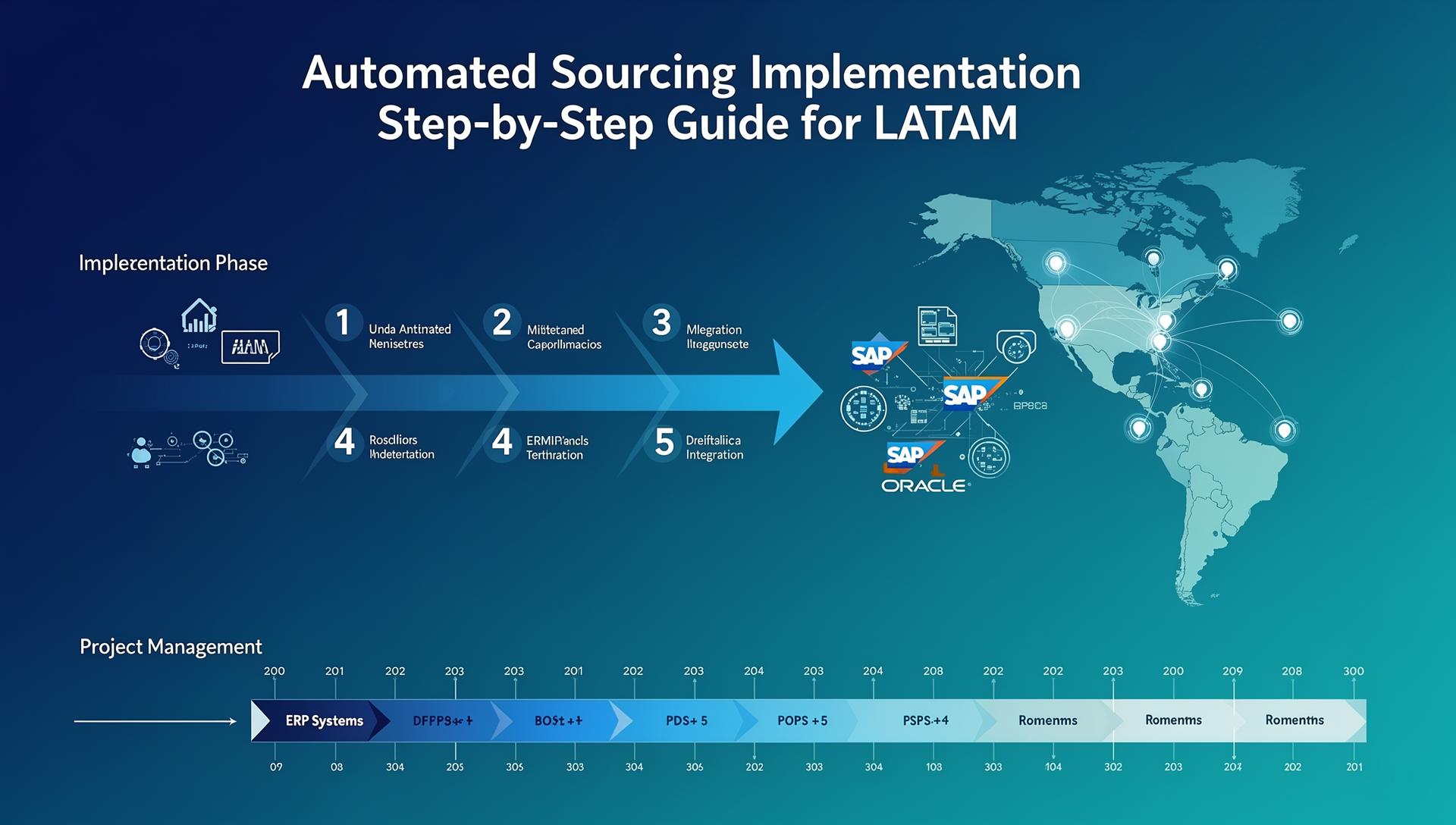
Full implementation takes 4-8 months following 7 steps: process mapping (2-4 wks), supplier database building (3-6 wks), agent configuration (2-3 wks), ERP integration (4-8 wks), pilot (4-6 wks), scaling (6-12 wks), and continuous optimization.
Key Takeaways
- Traditional sourcing takes 35-51 days; with AI it's reduced to 11-18 days (65-70% less)
- 7 structured steps guarantee successful implementation
- Integration with SAP, Oracle, and Totvs is critical for LATAM
- Master data cleansing is the most underestimated and crucial step
- Pilot should focus on a high-volume, low-complexity category
How Do I Implement Automated Sourcing with AI in My Company?
To implement automated sourcing with AI, you must follow a structured 7-step process:
- Process Mapping and Standardization: Document and standardize your current workflows
- Enriched Supplier Database Construction: Clean and enrich your supplier database
- AI Agent Configuration: Define the operational parameters of the agents
- Enterprise System (ERP) Integration: Connect the agents to your ERP (SAP, Oracle, Totvs, Siigo, Aspel)
- Controlled Pilot Execution: Test the solution in a limited environment
- Learning and Optimization: Iterate and improve based on pilot results
- Structured Scaling: Expand the solution to the rest of the organization
This guide details each of these steps with a practical approach for companies in Latin America.
The Sourcing Process: Before and After AI in LATAM
Visualizing the impact of automation is the first step to justify the investment. Below is a comparison of a traditional sourcing process in a Latin American company with one powered by AI agents.
| Process Phase | Traditional (Manual) Sourcing in LATAM | Automated Sourcing (with AI Agents) |
|---|---|---|
| 1. Identification | Manual requisition, multiple clarification emails. Time: 3-5 days | Structured intake form, automatic validation. Time: 1-2 days |
| 2. Search | Search in outdated internal databases, Google, references. Time: 5-7 days | Search across thousands of sources, automatic preliminary scoring. Time: 2-3 days |
| 3. RFI/RFQ | Manual document creation, individual sending, manual follow-ups. Time: 10-14 days | Automatic RFQ generation, mass sending with tracking, automatic response parsing. Time: 3-5 days |
| 4. Evaluation | Manual compilation in Excel, subjective scoring, consensus meetings. Time: 7-10 days | Automated comparative analysis, objective scoring, recommendation with explanation. Time: 2-3 days |
| 5. Negotiation | Sequential negotiations, ad-hoc documentation, cascading approvals. Time: 10-15 days | Automatic benchmarking, counteroffer suggestions, parallel approval workflows. Time: 3-5 days |
| Total Time | 35 - 51 days | 11 - 18 days (65-70% reduction) |
7-Step Implementation Guide
Step 1: Process Mapping and Standardization
What to do? Before automating, you must standardize. Document your current workflows to identify inefficiencies.
- Requisition intake: Define mandatory fields (category, budget, technical specifications, success criteria)
- Approval flows: Map who approves what and under what conditions (e.g., >$50k requires CFO approval)
- Evaluation criteria: Establish a standard scoring matrix (e.g., Price 40%, Quality 30%, Delivery 20%, Sustainability 10%)
Recommended tool: Use a BPMN (Business Process Model and Notation) tool like bpmn.io (free) or Lucidchart to visualize your flows.
Step 2: Enriched Supplier Database Construction
What to do? AI agents need quality data. Clean and enrich your supplier database.
- Master data cleanup: Eliminate duplicates, update contacts, and standardize categories in your ERP
- Enrichment: Add historical performance data, certifications (ISO, etc.), and financial risk (consult local credit bureaus)
- Consistent taxonomy: Establish a product/service categorization compatible with your ERP and international standards like UNSPSC
Step 3: AI Agent Configuration
What to do? Define your agents' operational parameters. On a platform like EGIXIA, this is done through a no-code interface.
- Search Agent: Configure sources to query (internal databases, public procurement portals, B2B marketplaces) and pre-qualification criteria
- RFQ Agent: Upload your RFQ templates by spend category and define follow-up rules
- Evaluation Agent: Assign weights to the evaluation criteria defined in Step 1
Step 4: Enterprise System (ERP) Integration
How do I integrate the agents with my current ERP in LATAM?
Integration is done through APIs (Application Programming Interfaces). A platform like EGIXIA has pre-built connectors for the most common ERPs in the region:
- For SAP (S/4HANA or Business One): REST/OData APIs are used to extract requisitions and create purchase orders. For older versions, BAPIs or flat files (iDocs) can be used
- For Oracle (NetSuite or Fusion): Oracle Cloud REST APIs are leveraged. For on-premise systems, a middleware layer can be used
- For local ERPs (Totvs, Siigo, Aspel): Each system's API documentation is reviewed. EGIXIA has experience integrating with the main ERPs in the region
Recommended architecture: Implement an abstraction layer (API Gateway) to avoid coupling agents directly to the ERP. This facilitates future changes if you decide to migrate ERPs.
Step 5: Controlled Pilot Execution (90 Days)
How do I demonstrate value quickly without risking the operation?
Execute a 90-day pilot in a low-risk, high-impact category:
- Pilot Selection: Choose an indirect spend category with many suppliers and transactions, such as "office supplies" or "digital marketing services"
- Ambassador Team: Select 2-3 innovative buyers open to change to lead the pilot
- A/B Comparison: Continue the manual process in parallel to objectively compare results
Pilot KPIs:
- Cycle time (from requisition to purchase order)
- Number of suppliers evaluated
- Savings generated vs. manual process
- User satisfaction (buyer and internal stakeholder)
- Agent adoption rate
Step 6: Learning and Optimization
What to do after the pilot?
- Structured feedback: Conduct 1-hour sessions with pilot users to identify frictions and improvement opportunities
- Exception analysis: Analyze when the AI agent had to escalate to a human. Was it necessary? Can it be automated in the future?
- Model retraining: Incorporate decisions made by humans during the pilot to improve AI model accuracy
- Configuration adjustments: Optimize scoring thresholds, pre-qualification criteria, and negotiation rules based on actual pilot results
Step 7: Structured Scaling
How do I expand the solution to the rest of the organization?
Scaling should be gradual and strategic, following a "wave" approach based on the complexity and impact of each spend category:
- Wave 1 (Month 4-6 post-pilot): Expand to all "tail spend" (low unit value, high transaction volume categories)
- Wave 2 (Month 7-9): Move towards commodities and standard services (e.g., freight, non-critical raw materials, cleaning services)
- Wave 3 (Month 10-12): Address strategic categories with intensive human supervision (e.g., critical production components, IT services, consulting)
What Mistakes Should I Avoid When Automating Sourcing in LATAM?
Based on our experience in over 50 implementations in the region, the most common mistakes are:
- Trying to automate a broken process: Automation scales efficiency, but also inefficiency. If your current sourcing process is chaotic, standardize it first (Step 1)
- Ignoring change management: Team resistance is the main cause of failure. Communicate a clear and transparent vision
- Choosing a provider without LATAM experience: A provider who doesn't understand the fiscal, logistical, and cultural complexities of the region will generate more problems than it solves
- Not cleaning supplier data: If your database is a mess (duplicates, outdated data, inconsistent categorizations), the AI results will be too. Remember the "Garbage In, Garbage Out" principle
- Measuring only cost savings: The value of AI is also in agility (faster time-to-market), risk reduction (fewer compliance errors, better supplier risk management), and freeing time for strategic activities
Integration with Common ERPs in LATAM
Integration with Enterprise Resource Planning (ERP) systems is critical for implementation success. Below are technical details about the most common ERPs in Latin America:
SAP (S/4HANA, Business One, Business ByDesign)
- Integration Approach: REST/OData APIs (for modern versions), BAPIs or iDocs (for legacy versions)
- Typical flow: The AI agent extracts purchase requisitions from SAP via API, executes the sourcing process, and automatically creates purchase orders in SAP
- LATAM Considerations: Many companies in the region still use old SAP ECC 6.0 versions. In these cases, middleware (e.g., SAP PI/PO) or flat files (iDocs) are required for integration
Oracle (NetSuite, E-Business Suite, Fusion)
- Integration Approach: Oracle Cloud REST APIs (for NetSuite and Fusion), SOAP web services (for E-Business Suite)
- LATAM Considerations: Oracle NetSuite is very popular in fast-growing companies in Mexico, Colombia, and Brazil. Its SaaS model facilitates integration
Totvs (Protheus, Datasul, RM)
- Integration Approach: Totvs' own REST APIs (documented on the Fluig portal), or integration via XML/CSV files
- LATAM Considerations: Totvs is the #1 ERP in Brazil. Integration may require custom development depending on the version and client customizations
Downloadable Resources for Your Implementation
To help you get started, we have prepared these templates based on best practices from implementations in Latin America:
- [Preparation Checklist for AI Sourcing Implementation] (PDF)
- [Business Case Template for Sourcing Automation] (PPTX)
- [AI Procurement Provider Evaluation Matrix] (XLSX)
- [Change Management Guide for Procurement Teams in LATAM] (PDF)
Next Steps: Start Your Transformation Today
Sourcing automation is no longer an option, it's a necessity to compete. Organizations that do not adopt these technologies in the next 2-3 years will be at a significant competitive disadvantage, both in costs and agility.
Schedule a Free Strategy Session
In 60 minutes, one of our AI implementation experts for procurement in LATAM will help you:
- Map your current sourcing process and identify "pain points"
- Identify bottlenecks and automation opportunities with the highest potential ROI
- Build a preliminary business case for your CFO, with conservative and realistic numbers
- Define next steps for a 90-day pilot, including the optimal category and ideal team
Frequently Asked Questions
Process mapping and standardization. You must document your current workflows, identify bottlenecks, and define the ideal state. Without this step, automation will only accelerate inefficient processes.
Topics